Part 2 of 3. A JobMarketPulse case study of the Product Manager job description at four major tech companies.
Part 1 covered what changed across Product Manager, Analyst, and Marketing Manager postings at Apple, Google, Microsoft, and Nvidia. Product Manager is where agent language shows up most, so this post goes through that job description in detail.
This is a case study of four companies, not a picture of the whole job market. The short version: between 2023 and 2026, these companies’ Product Manager postings moved from “machine learning” toward “generative AI,” “LLM,” and “agent.” They also mentioned go-to-market and user research less, product requirements more, and master’s degrees more than PhDs.
How we built this
Every posting comes from JobMarketPulse, which tracks the career sites of more than 400,000 companies worldwide. For this series, we picked four of them and read every Product Manager, Analyst, and Marketing Manager posting they published from 2023 to 2026. This post uses the 1,205 Product Manager postings.
A figure like “18.0% of postings” means 18.0% of those postings from all four companies in that year, unless we name a single company. The year-by-year numbers come from charts we built and checked. The Google and Apple figures come from summary totals, so we’ve checked those less closely.
Hiring volume went up, then settled
Before the language, a look at volume. Product Manager postings across the four companies went from 153 in 2023 to 376 in 2024, then 342 in 2025 and 334 in 2026. That’s about 11% below the 2024 peak and still more than double 2023.
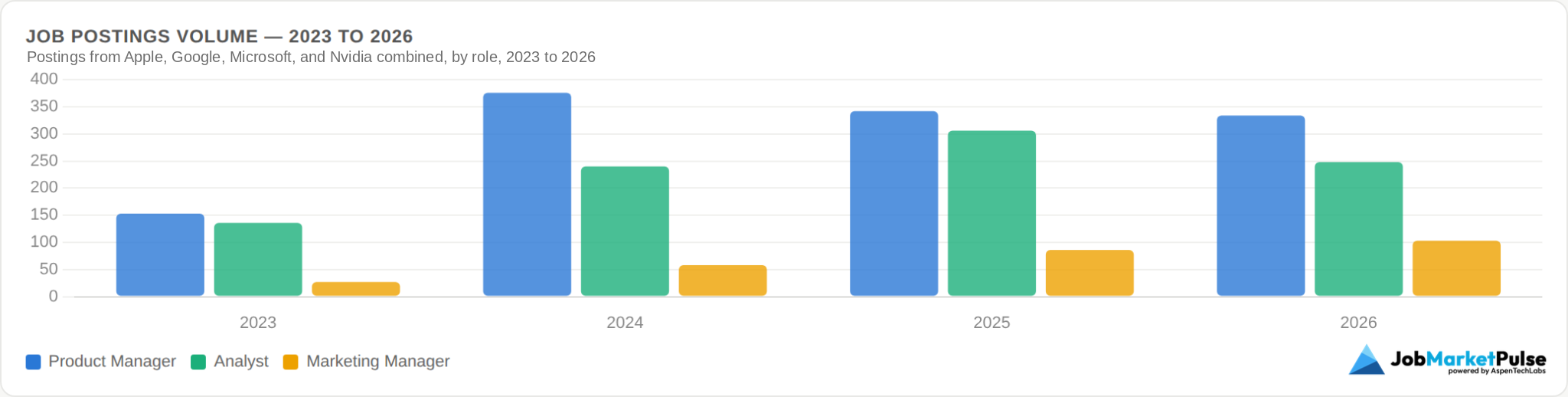
Figure 1: Job postings collected from Apple, Google, Microsoft, and Nvidia by role and year, 2023-2026, with Product Manager in blue
So the language changes below happened while the role was growing, and they kept going as volume eased. That doesn’t show AI shrank the Product Manager function, and it doesn’t show AI left hiring untouched. A pullback after a surge can have many causes, and our data can’t separate them.
“Machine learning” gave way to “generative AI” and “LLM”
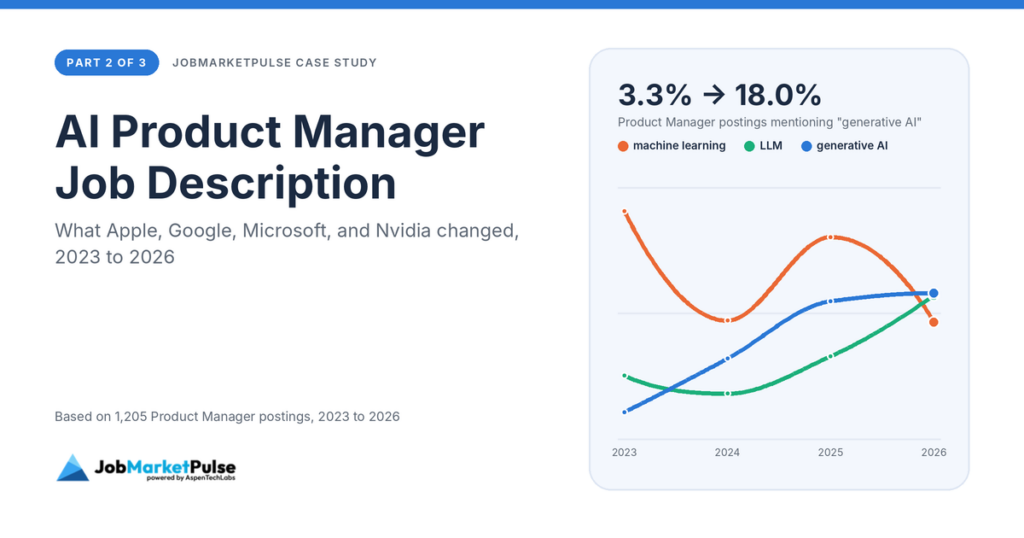
In 2023, “machine learning” was the most common of these three terms in Product Manager postings, at 28.1%. “Generative AI” was at 3.3% and “LLM” (large language model) at 7.8%. In 2026, “generative AI” was at 18.0% and “LLM” at 17.7%, both ahead of “machine learning” at 14.4%.
The path wasn’t smooth. “Machine learning” fell to 14.6% in 2024, rebounded to 24.9% in 2025, then fell back. “Generative AI” rose every year, though it flattened in 2026, from 17.0% to 18.0%. “LLM” dipped from 7.8% to 5.6% in 2024, then climbed to 10.2% in 2025 and 17.7% in 2026.
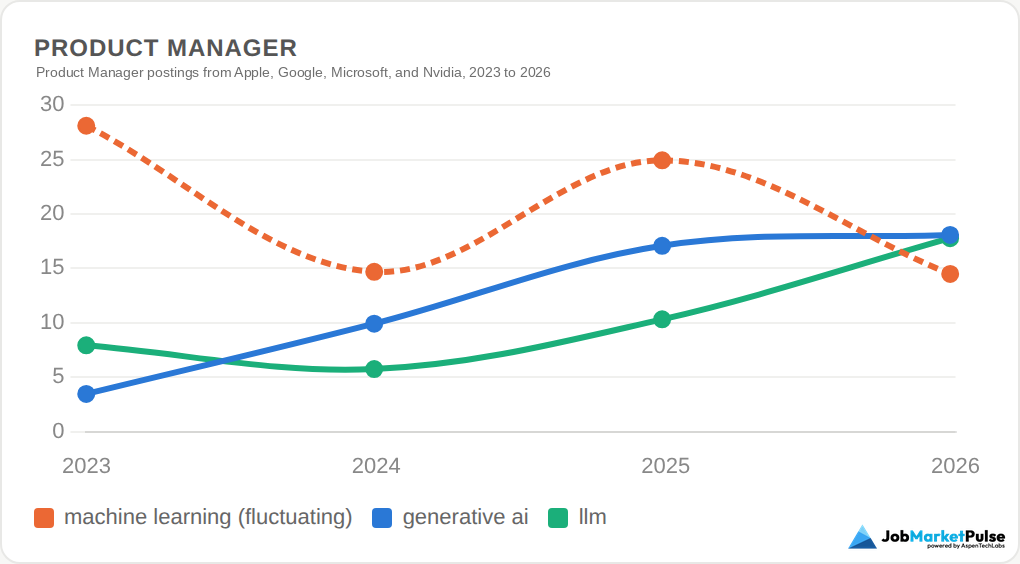
Figure 2: Machine learning language versus generative AI and LLM in Product Manager postings, 2023-2026
Our read is that these postings now name newer kinds of AI more often than the older umbrella term. The counts show the shift. They don’t show why it happened.
“Agent” is now the most common AI term we tracked
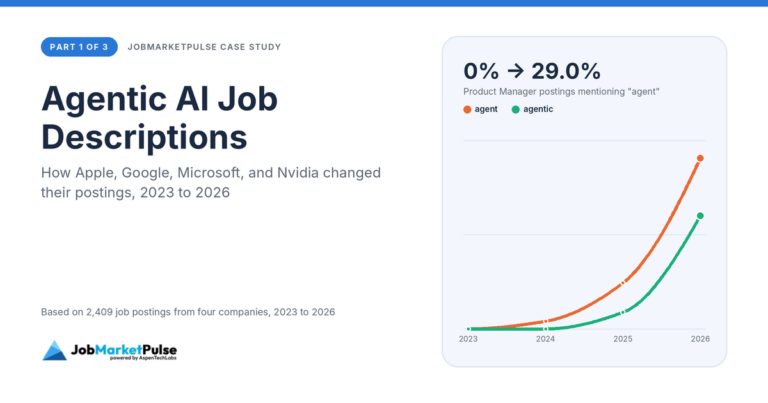
Add “agent” and “agentic” and the picture changes. In 2026, “agent” appeared in 29.0% of Product Manager postings. That’s more than “agentic” (19.2%), “generative AI” (18.0%), “LLM” (17.7%), or “copilot” (Microsoft’s AI assistant), which peaked in 2025 and fell back in 2026. Two years earlier, in 2024, “agent” was at 1.3%.
The jump is clearest at the two companies where we track it. At Microsoft, “agent” went from 25.9% of Product Manager postings in 2025 to 52.9% in 2026. At Nvidia, it went from 0% through 2025 to 48.1% in 2026.
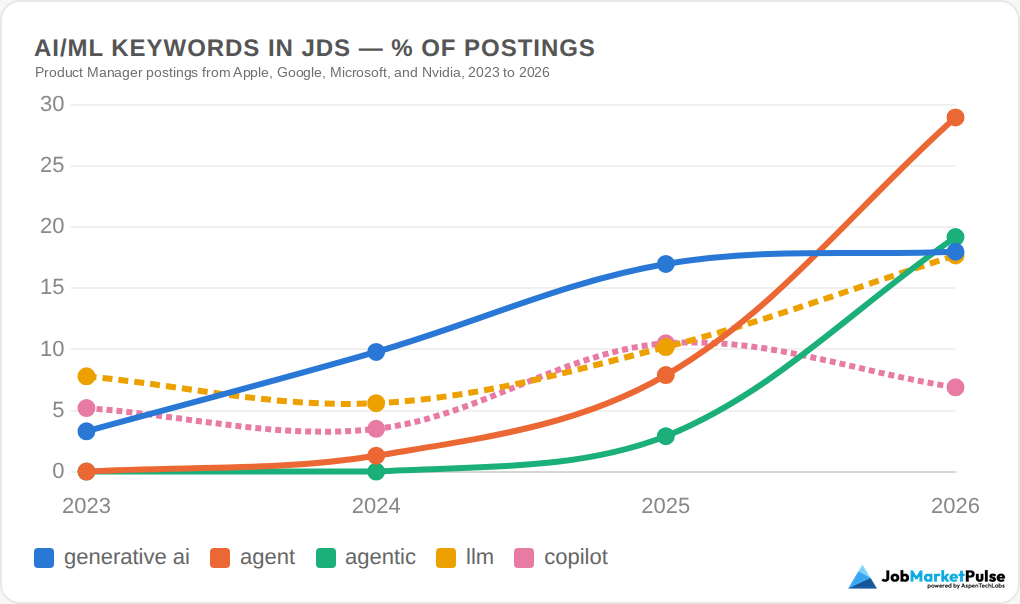
Figure 3: AI/ML keywords across all Product Manager postings: generative AI, agent, agentic, LLM, and copilot, 2023-2026
Part 1 explains what “agentic” means in a job description and why we hold the word loosely. For Product Manager postings, the point is that the fastest-growing of the AI terms we tracked is now also the most common one.
Less go-to-market and user research, more product requirements
The AI terms aren’t the only language that moved. “Go-to-market” appeared in 25.5% of Product Manager postings in 2023 and 15.3% in 2026. “User research” fell from 12.4% to 6.6%. “Product requirements” went the other way, from 13.7% to 21.0%, and mentions of “stakeholder” also rose.
That points toward postings putting more weight on writing requirements and coordinating across teams, and less on taking products to market and doing user research. It’s how these four companies describe the job, not a measurement of how the work changed. Part 3 comes back to go-to-market: it fell in Product Manager postings but stayed around 44% to 51% in Marketing Manager postings.
Fewer PhDs, more master’s degrees
Degree mentions moved in two clear directions and one unclear one. “PhD” appeared in 13.1% of Product Manager postings in 2023 and fell every year to 4.5% in 2026. “Master’s” rose every year, from 27.5% to 36.2%. “MBA” is the exception: it fell from 14.4% to 9.6% in 2025, then rose to 12.3% in 2026.
So the clearest change is a move from PhD to master’s, not a drop in graduate degrees overall. And calling the MBA path a decline overstates it, because it partly recovered.
How each company’s Product Manager postings changed
In 2026, two of the four companies mentioned “AI” in nearly every Product Manager posting, and two mentioned it in about half.
Nvidia started highest and ended at the ceiling: “AI” appeared in 55.6% of its Product Manager postings in 2023 and 100% in 2026. Microsoft had the steepest climb: 31.5% in 2023, a dip to 20.9% in 2024, then 64.8% in 2025 and 90.2% in 2026. Google and Apple rose more gradually, from roughly 5% to 50% at Google and roughly 6% to 46% at Apple.
Frequently asked questions
What skills do AI product manager job descriptions ask for? At Apple, Google, Microsoft, and Nvidia in 2026, the most common AI terms in Product Manager postings were “agent” (29.0%), “agentic” (19.2%), “generative AI” (18.0%), “LLM” (17.7%), and “machine learning” (14.4%). “Product requirements” appeared in 21.0% of postings and “go-to-market” in 15.3%.
Do product manager job descriptions require a master’s degree? Most don’t mention one. At these four companies in 2026, 36.2% of Product Manager postings mentioned a master’s degree, up from 27.5% in 2023. “MBA” appeared in 12.3% and “PhD” in 4.5%. These are mentions, not confirmed requirements.
Is product manager hiring going up or down? At these four companies, Product Manager postings rose from 153 in 2023 to a peak of 376 in 2024 and were 334 in 2026, still more than double the 2023 level. That’s four companies, not the whole market.
What comes next in this series
Part 3 covers Analyst and Marketing Manager, where the story gets messier: a one-year hiring spike that isn’t a trend, and go-to-market language that stayed put while Product Manager’s fell. Read Part 3
Want this for your own competitive set?
JobMarketPulse tracks more than 400,000 companies and 11.5 million live jobs worldwide, including 6.4 million live jobs in the U.S., about 70% of the U.S. market. Our JobsIndex database goes back to September 2022 and refreshes daily. If you want this kind of analysis run against a different set of employers or roles, reach out to our research team, and we’ll scope it out.
About Aspen Technology Labs
Aspen Technology Labs, Inc. is a global leader in recruitment technology, labor market and wage analytics, and web data management services. Founded in 2008 and headquartered in Aspen, Colorado, Aspen’s JobMarketPulse platform delivers real-time labor market intelligence built to be easy to use and understand, no data science degree required. As of October 6, 2026, Aspen collects job posting data from more than 400,000 companies across 195 countries, including more than 260,000 with jobs posted in the U.S., and serves more than 300 customers.
See this data in action
Explore structured job data and labor market intelligence for your use case.