What our own postings data shows about HR hiring, held up against SHRM’s reporting that talent acquisition teams are shrinking nationally in 2026, and what’s probably actually inside that number
Every recruiter has heard some version of this by now. AI is doing the screening. AI is doing the scheduling. Talent acquisition teams are getting smaller, not bigger, and the people doing the cutting are often the recruiters themselves. It’s a clean story, it’s backed by real reporting, and it matches what a lot of people in this industry are feeling right now.
It’s also only half of what our own data shows.
We track HR job postings every day across more than 300,000 employer career sites. In our own numbers, HR isn’t shrinking. As of August 2026, it’s the second-fastest-growing job category we track, out of 31, behind only Engineering. Both things are true in the same window of time, and once you look closely, they’re not actually the contradiction they look like at first.
Three numbers worth sitting with
Start with the one that surprised us most. Across the 31 job categories we track monthly, from Restaurants down to Real Estate, HR ranked second by year-over-year growth in August, at 18.4%. Only Engineering, at 25.4% and tied directly to data center and AI infrastructure buildout, grew faster. HR beat Information Technology (16.6%) and Science (17.2%), the two categories most people would guess are riding the same AI wave. It also beat the broader white-collar segment HR sits within, which grew 7.7% YoY, a real number, just less than half of HR’s own rate.
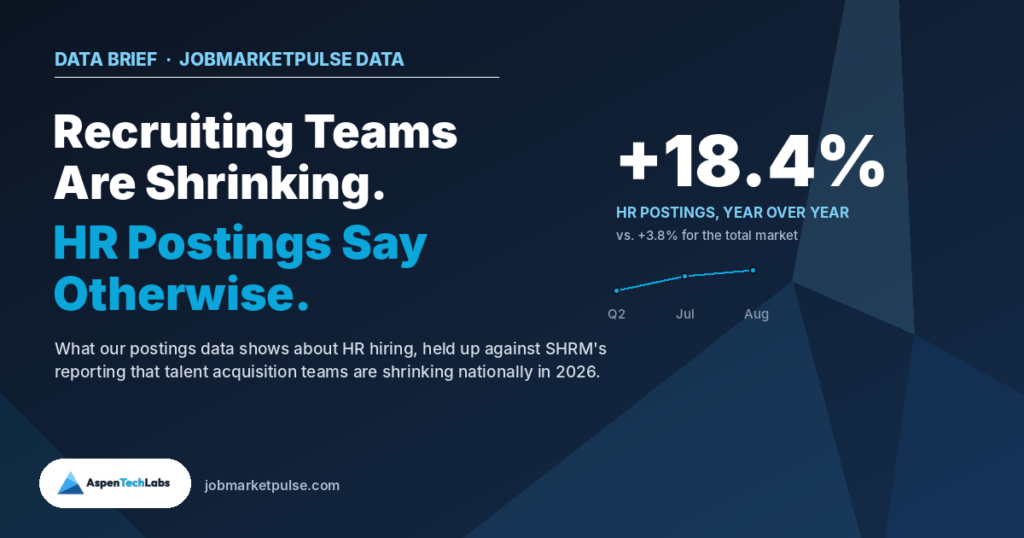
That 18.4% didn’t arrive in one jump. It’s the third reading in a row in the same direction: 15.7% in Q2, 17.6% in July, 18.4% in August, against a total market growing 3.7%, 3.9%, and 3.8% over the same three windows. Three straight months of acceleration is a materially different claim than one good quarter. We first flagged this as an outlier in “How Four Leading Technology Companies Rewrote Existing Roles for the AI Era,” our earlier look at what Q2 2026 JobMarketPulse data shows about AI and hiring, and every reading since has made the outlier sharper, not smaller.
It’s also still a small-base number relative to the categories most people talk about. HR postings totaled 33,494 in August, ranking 25th of 31 categories by volume, well below Restaurants, Retail, Healthcare, Nursing, and Education at the top, and a fraction of Engineering’s 150,721 or IT’s 197,427. Fast growth and small scale aren’t in tension; they’re both true, and both matter: the growth rate is real and rare, the base it’s growing from is still modest next to the categories that dominate headline hiring numbers.
An independent source lands close to the same scale, for what it’s worth as a cross-check. Robert Half’s own 2026 research on HR hiring counted roughly 30,300 HR postings in its own sample, separately from ours, using its own methodology. More than half of those, about 16,500, were for talent management or learning and development roles specifically, not recruiting or sourcing roles. That detail turns out to matter more than the headline growth number does.
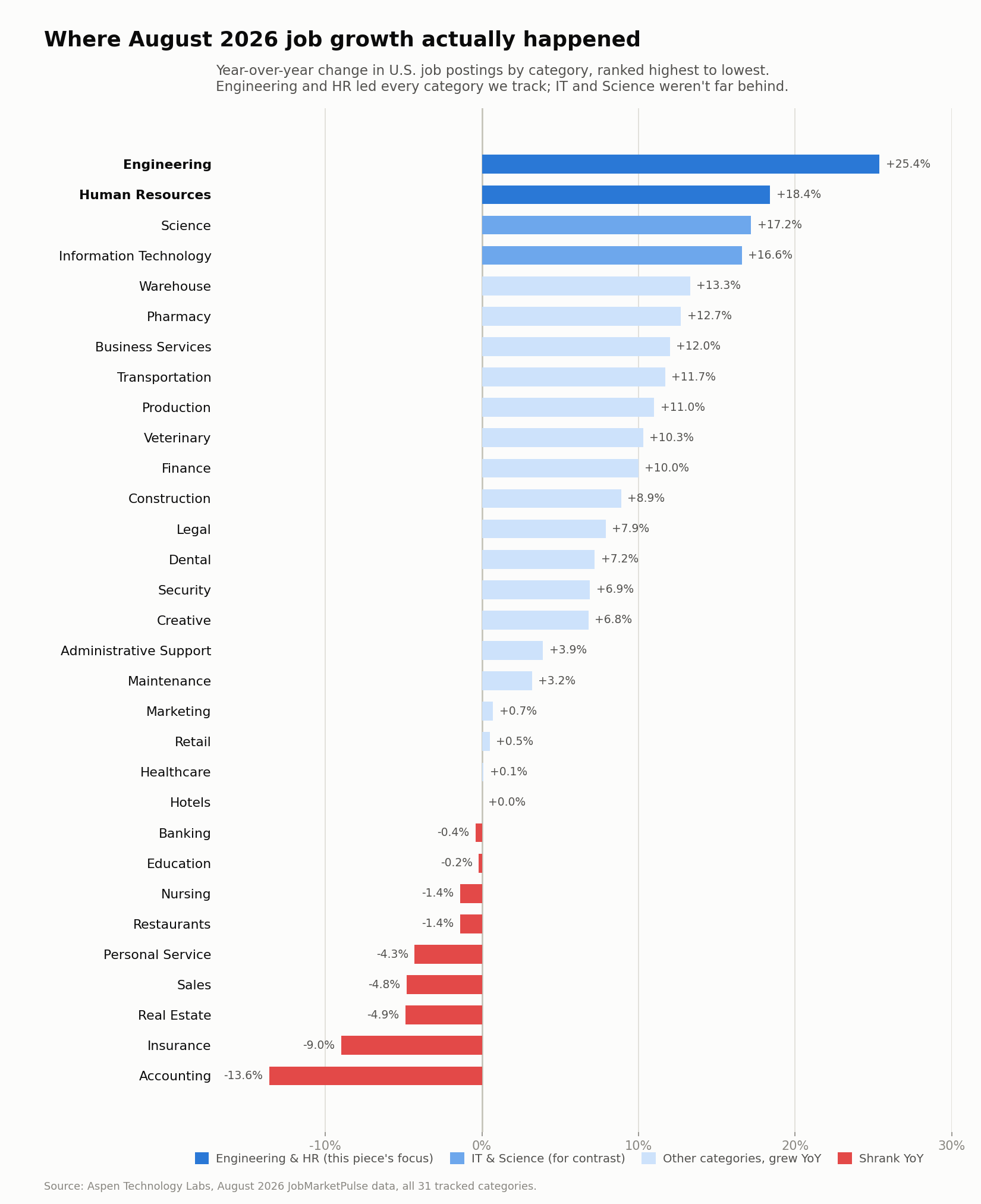
Figure 1: Ranking 31 tracked categories by August 2026
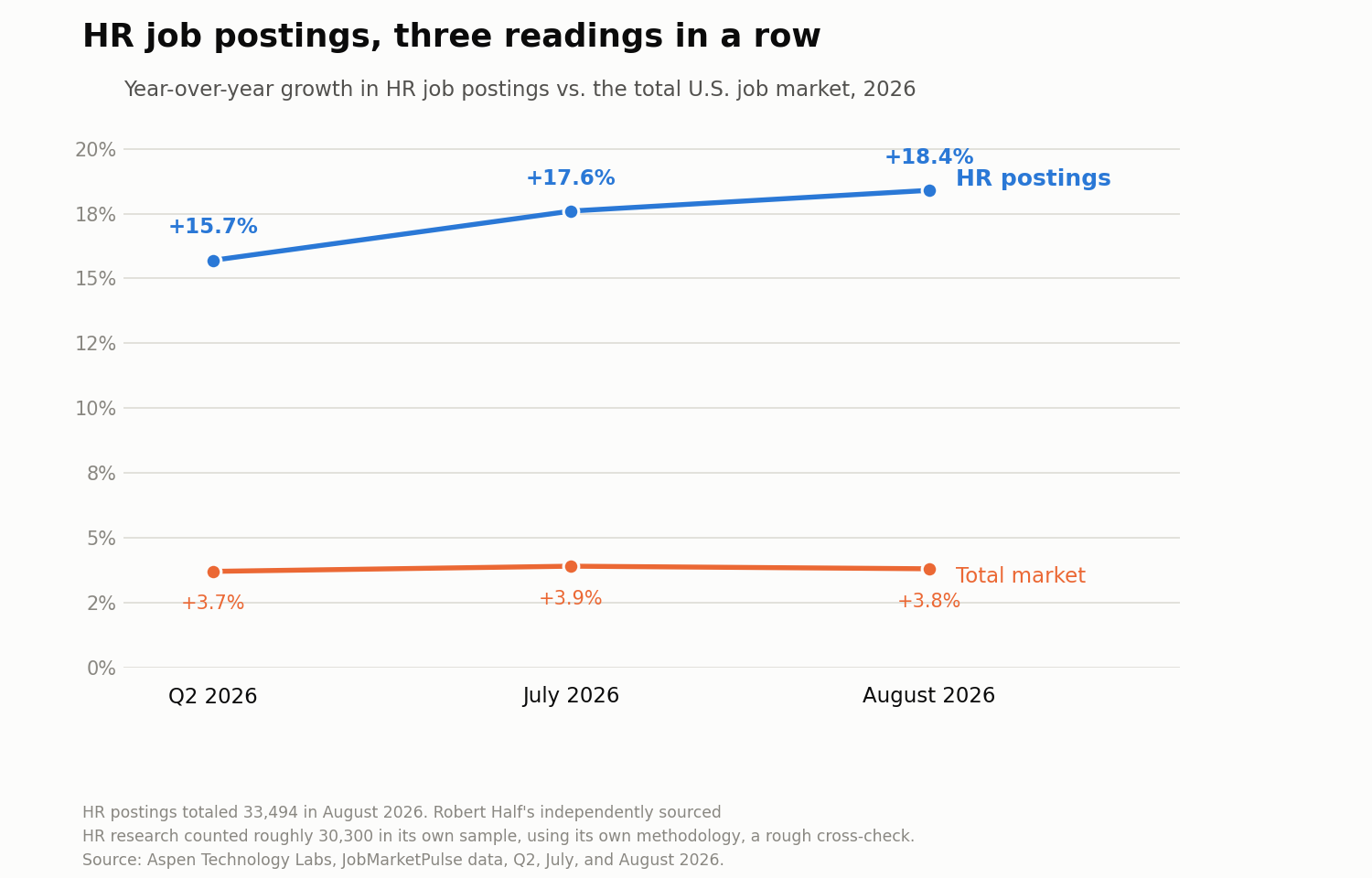
Figure 2: HR postings vs total market growth
What “talent acquisition teams are shrinking” is actually built on
Worth being precise about what the shrinking-TA-teams story is, and isn’t, built on. SHRM’s 2026 reporting on talent acquisition doesn’t cite a specific headcount statistic. It’s a qualitative piece built from interviews with people close to the hiring function, and their read is fairly consistent.
In interviews SHRM ran for that same 2026 piece, Johnny Campbell, CEO of Social Talent, framed 2026’s slower hiring environment as permanent rather than cyclical: “The ‘low hire, low fire’ environment that defined 2025 isn’t temporary. It’s the new baseline.” Matt Charney, of Kyle & Co, described a stricter approval bar for every open role: “Every hire that does get approved must be business-critical.” Eleesha Martin of G&A Partners tied it to a shift in what TA teams are judged on: “Quality of hire matters more than volume, and internal mobility becomes a competitive advantage.”
The AI framing is in there too, and it’s more hedged than the popular version of this story. In the same SHRM reporting, Matt Charney also said, “2026 is the year autonomous agents move from the margins to the mainstream of recruitment,” which is a claim about direction, not a claim that it’s already happened at scale. And Gartner’s Jamie Kohn added a note that cuts against the simplest version of the AI-replacing-recruiters story: “We’ve overestimated the value of AI in some areas… This is the year of the AI reality check.”
So the shrinking-TA-teams story, read closely, is really two claims stacked together: hiring overall has slowed and gotten more selective, and AI is starting to absorb some of the manual work recruiters used to do, though even Gartner’s own analyst is telling HR leaders not to overestimate how far that’s gone yet. Neither claim is about HR headcount broadly. Both are specifically about the recruiting function inside HR.
What’s probably inside our HR growth number
That distinction is the thing that makes our own data make sense rather than contradict SHRM’s reporting.
“HR” in our data isn’t just recruiters. It’s every HR-tagged posting: HR generalists, HR business partners, benefits and compensation managers, HR directors, compliance roles, people analytics, and talent management and L&D roles alongside recruiting and sourcing roles. Robert Half’s finding that talent management and L&D make up over half of current HR postings points toward where the actual growth is concentrated, and it isn’t recruiting.
That lines up with the demand-side numbers from Robert Half’s same 2026 HR research: 56% of HR leaders said they planned to increase permanent HR headcount in the second half of 2026, 59% said it’s gotten harder to find skilled HR talent than a year earlier, and 58% said project delays from HR skills shortages had already hit their teams. None of those numbers are about recruiters specifically. They describe an HR function that’s stretched and hiring around functions like compensation design, compliance, and workforce analytics, categories that don’t disappear just because AI is handling more resume screening.
We haven’t pulled a title-level breakdown of our own HR category yet to confirm this directly, so treat it as a well-sourced hypothesis rather than a finding: the postings growth is probably concentrated in non-recruiting HR roles, while recruiting and sourcing specifically may be flat or shrinking inside a category that’s growing overall. That’s a checkable claim, and it’s the next thing worth pulling.
What “shrinking” looks like when you can see it happen
For a concrete look at what a shrinking TA team actually looks like operationally, LinkedIn’s own 2026 layoffs are a useful, specific example rather than an abstraction. According to one industry analysis of the cuts, the company cut roughly 875 roles, about 5% of its workforce, in a round CEO Daniel Shapero described as a reorganization. Recruiter-tools teams were among the groups affected, alongside trust-and-safety and content moderation staff.
The more interesting detail isn’t the headcount number. It’s what happens to the systems those people used to maintain. With fewer people tuning recruiter-facing tools and reviewing edge cases, that same analysis argues the pipeline both recruiters and candidates depend on gets “narrower and noisier.” That’s worth watching alongside a question we’ve been sitting with in our own planning: whether signal quality in job postings can degrade even where raw posting activity looks fine. It’s a different mechanism than “AI replaced these jobs,” and it’s worth keeping the two apart.
What we’d check next
A few things would turn this from an interesting gap into something closer to a settled finding, and we’re flagging them the same way we would in any of our own reports:
A title-level cut of our own HR category, separating recruiter and sourcer postings from HRBP, compensation, compliance, and L&D roles, would tell us directly whether recruiting specifically is flat or shrinking within HR’s overall growth, rather than relying on Robert Half’s separately sourced number as a proxy. That’s still the single most useful pull left to do.
We already have the additional data point we were waiting for. HR’s growth kept climbing through August rather than plateauing, three readings in a row, each higher than the last. That’s a stronger signal than the two-quarter run we had when this piece was first drafted, and it raises the bar for what would actually reverse the story: not a soft month, but a real break in the trend.
Geographic and company-size cuts are also worth pulling. We’ve broken out regional hiring differences before, and it’s possible this growth is concentrated in specific states or in larger employers building out HR functions that smaller companies can’t afford to staff the same way right now.
Frequently asked questions
Are talent acquisition teams actually shrinking in 2026? According to SHRM’s 2026 reporting on talent acquisition, industry voices, including Social Talent CEO Johnny Campbell, describe talent acquisition teams as shrinking alongside slower, more selective hiring. The reporting is based on interviews rather than a specific headcount statistic.
Are HR job postings growing or shrinking in 2026? In our own JobMarketPulse data, HR job postings are growing, not shrinking. They were up 15.7% year over year in Q2 2026, 17.6% by July, and 18.4% by August, ranking as the second-fastest-growing job category out of 31 we track that month, behind only Engineering, though the category is still a small share of total postings by volume.
What is the fastest-growing job category in 2026? Engineering was the fastest-growing job category in Aspen Tech Labs’ August 2026 data, up 25.4% year over year, tied to data center expansion and AI infrastructure investment. Human Resources ranked second at 18.4%, ahead of both Information Technology (16.6%) and Science (17.2%).
Why are HR job postings growing if recruiting teams are shrinking? The most likely explanation, based on Robert Half’s 2026 HR hiring research, is that HR posting growth is concentrated outside recruiting. Their data found more than half of current HR postings are for talent management and learning and development roles, not recruiting or sourcing, alongside rising demand for compensation, benefits, and compliance specialists.
Is AI actually replacing recruiter jobs in 2026? The evidence is mixed and more cautious than the popular framing suggests. Gartner’s Jamie Kohn, quoted in SHRM’s 2026 talent acquisition reporting, describes this as “the year of the AI reality check,” warning that AI’s value in recruiting has been overestimated in some areas, even as slower hiring and more selective approval processes are independently shrinking recruiting headcount.
What roles are driving HR hiring growth in 2026? External research from Robert Half points to talent management, learning and development, compensation and benefits, and compliance-adjacent roles as the likely drivers, rather than recruiting and sourcing roles specifically. Aspen Tech Labs has not yet published a title-level breakdown of its own HR postings to confirm this directly.
Where this leaves us
Two credible sources, looking at the same time window, describe different parts of the same function. SHRM’s reporting says talent acquisition teams, recruiters specifically, are shrinking as hiring slows and AI absorbs more manual work. Our own data says HR postings are the second-fastest-growing category we track, out of 31, faster each month for three months running, and faster than IT or Science, the categories usually credited with riding the same AI wave. Robert Half’s independent numbers suggest the reason those two things don’t actually collide: the growth is probably sitting in HR roles that aren’t recruiting at all.
That’s a more useful answer than picking a side, and it’s still not confirmed. We’ll pull our own title-level cut of the HR category next, and we’ll report it either way, whether it confirms this or complicates it further.
About Aspen Technology Labs
Aspen Technology Labs, Inc. (Aspen) is a global leader in recruitment technology, labor market and wage analytics, and web data management services. Founded in 2008 and headquartered in Aspen, Colorado, the company supports clients across the U.S., Europe, and the Middle East. Aspen’s JobMarketPulse platform delivers real-time labor market intelligence, helping employers, analysts, and policymakers navigate a rapidly evolving hiring landscape. With expanding coverage of companies, job postings, and compensation data, Aspen continues to enhance its tools to meet the demands of a shifting economy and an increasingly data-driven talent market. As of June 1, 2026, Aspen collects job posting data from over 400,000 companies worldwide, including more than 260,000 in the United States, spanning both public and private employers.
See this data in action
Explore structured job data and labor market intelligence for your use case.