Part 3 of 3. A JobMarketPulse case study of the Analyst and Marketing Manager job descriptions at four major tech companies.
Part 1 covered what changed across Product Manager, Analyst, and Marketing Manager postings at Apple, Google, Microsoft, and Nvidia. Part 2 went through the Product Manager job description. This post covers the other two roles, and it closes the series.
This is a case study of four companies, not a picture of the whole job market. The short version: Analyst postings moved toward “LLM” and “agent” language, but one Apple contract title distorts the 2025 numbers. Marketing Manager postings grew the fastest, and AI language went into the existing Product Marketing Manager title instead of a new one.
How we built this
Every posting comes from JobMarketPulse, which tracks the career sites of more than 400,000 companies worldwide. For this series, we picked four of them and read every Product Manager, Analyst, and Marketing Manager posting they published from 2023 to 2026. This post uses the 930 Analyst postings and the 274 Marketing Manager postings.
A figure like “15.3% of postings” means 15.3% of that role’s postings from all four companies in that year, unless we name a single company. The year-by-year numbers come from charts we built and checked. The Marketing Manager title counts come from summary totals, so we’ve checked those less closely.
Analyst: two titles moved the counts
Analyst is the hardest of the three roles to read, because two titles moved the counts and neither is mainly about AI.
Across the four companies, Financial Analyst postings grew from 16 in 2023 to 68 in 2026, the biggest title change in the data. That growth tracks an expansion of finance hiring at Google and Apple, not AI.
Annotation Analyst is a contract title at Apple tied to Siri. We found 48 of these postings, all at Apple, and 39 of them came in 2025. In 2026, there were none. “Machine learning” appeared in none of these postings in 2023 and in all of them in 2025. That is one hiring cycle at one company, not a trend.
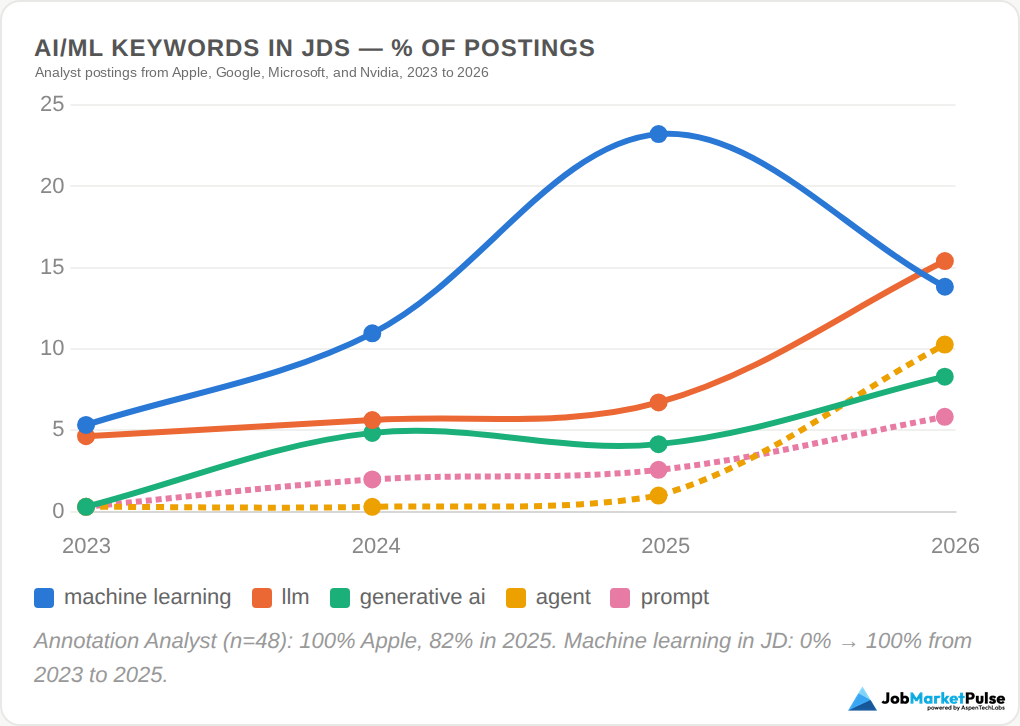
Figure 1: AI/ML keywords across all Analyst postings: machine learning, LLM, generative AI, agent, and prompt, 2023-2026
The Annotation postings matter because of what they do to the chart. Across all Analyst postings at the four companies, “machine learning” jumped to 23.2% in 2025, then fell to 13.7% in 2026. Those 39 Annotation postings were about 13% of that year’s Analyst postings, and all of them used the phrase. So much of the 2025 spike comes from one Apple title, not from Analyst jobs in general.
“LLM” is the cleaner signal. It rose from 4.4% of Analyst postings in 2023 to 15.3% in 2026. “Agent” went from near zero to 10.1% in 2026, and “agentic” reached 4.4%.
The core tools mostly held. Excel stayed between 67% and 70% of Analyst postings. From 2023 to 2026, SQL rose from 28.7% to 50.0%, and Python from 19.9% to 33.1%. Power BI fell from 14.7% to 5.6%.
By company, Nvidia’s Analyst postings carry the most AI language of the four, with “GPU” and “AI” language above 60% in 2025 and 2026. Microsoft’s Analyst sample is only 60 postings, so its swings are small-base swings. Apple’s numbers are skewed by the Annotation Analyst wave.
Marketing Manager: the smallest role, and the fastest growing
Marketing Manager is the smallest of the three roles at 274 postings across the four companies. It also grew the fastest, with postings across the four companies up 281% between 2023 and 2026.
Not one of those postings used “AI Marketing Manager” as a title. Across the four companies, Product Marketing Manager grew from 12 postings to 63 and now makes up 62% of Marketing Manager postings. Whatever AI is changing in marketing hiring at these four companies, it is showing up inside that existing title.
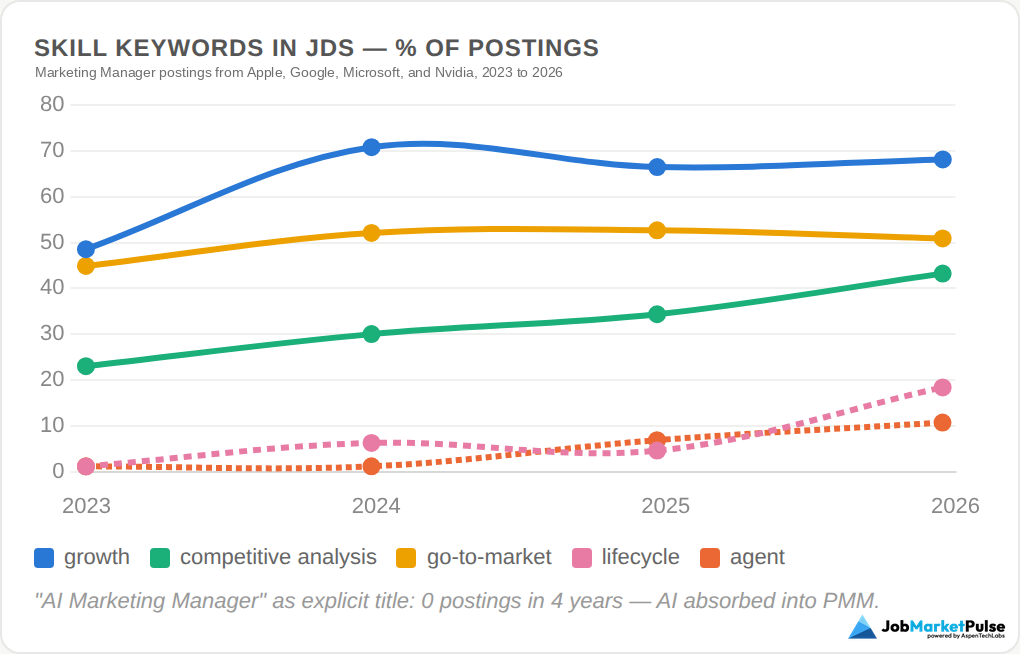
Figure 2: Skill keywords across all Marketing Manager postings: growth, competitive analysis, go-to-market, lifecycle, and agent, 2023-2026
Between 2023 and 2026, the skill words moved too. “Growth” rose from 48.1% of Marketing Manager postings to 68.0%, “competitive analysis” from 22.2% to 42.7%, and “lifecycle” from 0% to 17.5%. “Value proposition” fell from 33% to 21%. That points toward postings asking for more work on growth and the customer lifecycle, and less on writing the pitch. It’s how these companies describe the job, not a measurement of the work itself.
“Agent” appeared in 9.7% of Marketing Manager postings in 2026, and “agentic” in 6.8%.
Go-to-market held in marketing while it fell in product
Part 2 showed “go-to-market” falling in Product Manager postings, from 25.5% in 2023 to 15.3% in 2026. In Marketing Manager postings, it went the other way, from 44.4% to 50.5%.
Read side by side, these four companies’ postings put go-to-market more firmly in the marketing job and less in the product job. That fits a pattern of the work moving toward marketing teams. Postings can’t confirm that, only show how the roles are described.
How each company’s Marketing Manager postings changed
Microsoft’s change is the clearest. “Copilot,” the name of its AI assistant, went from 0% of Microsoft’s Marketing Manager postings in 2023 to 45.5% in 2026, and “AI” went from 28.6% to 90.9%.
Nvidia’s Marketing Manager postings mentioned “AI” 100% of the time in 2025 and held there in 2026. Its product word, “GPU,” fell from 81.8% in 2025 to 62.5% in 2026. Part 1 covers that pattern in more detail. We don’t have the same Marketing Manager cut for Google and Apple.
What the series showed
Across Product Manager, Analyst, and Marketing Manager postings at Apple, Google, Microsoft, and Nvidia, the pattern was the same: these companies rewrote the jobs they already had instead of creating new AI jobs. AI-branded titles stayed under 5% of each role’s postings in every year from 2023 to 2026.
The AI language changed more than the titles did. In 2026, “agent” appeared in 29.0% of Product Manager postings, 10.1% of Analyst postings, and 9.7% of Marketing Manager postings. Product Manager postings moved from “machine learning” toward “generative AI” and “LLM” between 2023 and 2026. Analyst postings showed a similar rise in “LLM,” from in 2023 to 15.3% in 2026.
The rest of each job description shifted in ways specific to the role. Product Manager postings mentioned go-to-market and user research less and product requirements more, and master’s degree mentions rose while PhD mentions fell. Marketing Manager postings kept go-to-market at about half of postings and added more growth and lifecycle language. At Microsoft and Nvidia, a company’s own product word, “copilot” or “GPU,” peaked and then slipped while a more general AI word held or grew.
Two cautions apply. Four companies are not the whole market, and counting words shows how a company describes a job, not what the person does all day. And some swings came from small bases or a single title, like Apple’s Annotation Analyst postings.
Frequently asked questions
How have analyst job descriptions changed with AI? At Apple, Google, Microsoft, and Nvidia, “LLM” rose from 4.4% of Analyst postings in 2023 to 15.3% in 2026, and “agent” reached 10.1%. Excel stayed between 67% and 70%, while SQL rose from 28.7% to 50.0%. “Machine learning” spiked to 23.2% in 2025 and fell to 13.7%, partly because of one Apple contract title.
Is there an AI marketing manager job title? Not at these four companies. None of the 274 Marketing Manager postings used “AI Marketing Manager.” AI language went into existing titles, mainly Product Marketing Manager, which makes up 62% of Marketing Manager postings.
Do marketing manager job descriptions still ask for go-to-market experience? At these four companies, yes. “Go-to-market” appeared in 44.4% of Marketing Manager postings in 2023 and 50.5% in 2026, while it fell from 25.5% to 15.3% in Product Manager postings. That’s four companies, not the whole market.
Read the rest of the series
Want this for your own competitive set?
JobMarketPulse tracks more than 400,000 companies and 11.5 million live jobs worldwide, including 6.4 million live jobs in the U.S., about 70% of the U.S. market. Our JobsIndex database goes back to September 2022 and refreshes daily. If you want this kind of analysis run against a different set of employers or roles, reach out to our research team, and we’ll scope it out.
About Aspen Technology Labs
Aspen Technology Labs, Inc. is a global leader in recruitment technology, labor market and wage analytics, and web data management services. Founded in 2008 and headquartered in Aspen, Colorado, Aspen’s JobMarketPulse platform delivers real-time labor market intelligence built to be easy to use and understand, no data science degree required. As of October 6, 2026, Aspen collects job posting data from more than 400,000 companies across 195 countries, including more than 260,000 with jobs posted in the U.S., and serves more than 300 customers.
See this data in action
Explore structured job data and labor market intelligence for your use case.