Our job posting data is now available in more places than ever, via direct API, on developer marketplaces, through cloud data exchanges, and on a financial services platform built specifically for institutional buyers.
But not all of these are the same thing, and that’s intentional.
Depending on where you access the data, you’ll find different fields, different coverage, and different delivery formats, each designed for the audience and workflow it’s serving. This post breaks down what’s live right now, where to find it, and what to expect depending on where you’re looking.
For most of our history, if you wanted our job data, you called us. We built custom feeds, ran scraping pipelines to spec, and negotiated contracts around what you actually needed. We still do all of that. But people increasingly want to poke at data before committing to it, the way you’d try any API. That’s why JobsIndex and Wage Data are now live via API; you can test them directly on Apify, on RapidAPI, or reach out directly, and we’ll schedule a test for you.
On top of the API, our general job posting data lives on AWS Data Exchange, and a sample of a separate dataset built specifically for financial services, covering the Russell 3000 and STOXX 600, is published on BattleFin, with the full dataset available on request.
What Is Job Posting Data, and How Is It Different From Other Datasets?
Jobs data is just what it sounds like: structured info about open roles, pulled from where companies actually post them, their ATS and career pages, not lifted secondhand from a job board. It represents a company’s hiring activity and intent.
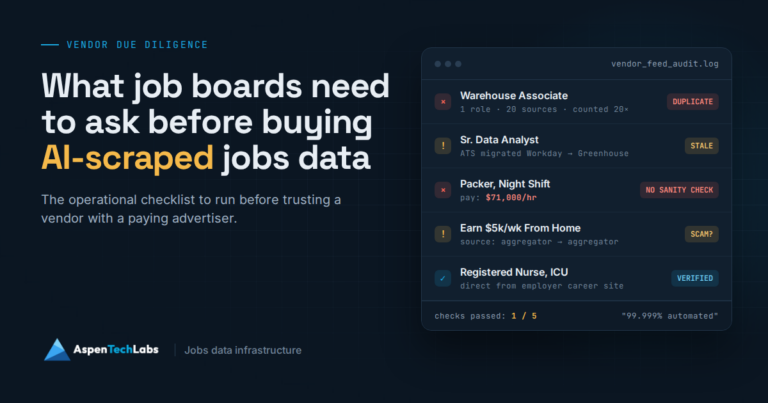
That sourcing choice matters more than it sounds like it should. Aggregators tend to replicate jobs, listing the same job several times over as they get it from several partners, which creates a terrible candidate experience, broken URLs, and confusion for candidates. Going straight to the employer skips all of that: no duplicates, no lag, and you know exactly where and when a job actually went live.
It’s also why people outside of recruiting care about this. What a company is hiring for right now is one of the freshest public signals of what it’s actually doing, where it’s growing, what it’s betting on. Recruiters use it to catch openings the second they appear. Job boards use it to keep their listings from going stale. Financial and research teams use it to spot growth or trouble before either one shows up in an earnings call.
JobsIndex is the largest database of over 11M active organic jobs, updated daily, pulled from 300K+ source sites worldwide, with 175K+ in the US alone.
What Is the JobsIndex API?
The JobsIndex API gives you direct, queryable access to that same database: 11M+ active job listings from 300K+ source sites worldwide, 175K+ in the US. It pulls directly from ATS platforms and career pages, not from aggregators, and updates daily. You can filter by location, title, industry, salary, seniority, employment type, and more.
We’ve spent over a decade building custom scraping solutions for job boards, aggregators, and recruitment marketing firms. JobsIndex grew out of that work; it’s the largest continuously updated index of direct-source job postings out there.
JobsIndex API and Wage Data API: What’s Live Now
Two of three planned products are live, or close to it. Here’s where things stand:
JobsIndex API, live now. Filter by what, where, title, salary, seniority, posted, and more.
Jobs with Salary API, live now. Individual US job postings that include employer-disclosed salary data directly in the listing, raw, posting-level compensation data rather than aggregated analytics.
Wage Data API, coming soon. An analytics layer on top of that same data, aggregated salary insights across roles, industries, and geographies rather than individual postings.
Labor Market Intelligence API, coming next. Hiring trends, competitive intelligence, workforce shifts, all queryable via API instead of locked inside a dashboard.
There’s also a full labor market intelligence platform coming, already in beta. Reach out if you want early access.
Access the JobsIndex API Directly
You don’t need a marketplace in between. Check the API documentation for the full parameter list, or start a free trial to get a data sample and a working API key.
The API takes a wide range of filters: “what” for keyword search (with Boolean AND/OR/NOT), plus “where,” “country,” “region,” “city,” “postal_code,” “title,” “company_domain,” “category,” “industry,” “posted,” “salary,” “employment_type,” and “seniority.” Pagination runs through “page” and “size.”
Responses come back as clean JSON: metadata (page, size, total, pages) up top, then a data array with the job details, title, category, seniority, posted date, location fields, salary, employment type, and a link back to the source.
New to JobsIndex? A 2-week free trial gets you a sample and lets you see the API working before you commit to anything.
Apify vs. RapidAPI: Two Ways to Test It
You can also test the JobsIndex API through two developer marketplaces.
Apify hosts a growing set of Actors built on our underlying data. Beyond the core Jobs Index Actor, there are narrower ones built for specific use cases, including a Remote Jobs API and the Jobs with Salary API, which cover US postings with employer-disclosed compensation data. Pricing is pay-per-result and varies by Actor. Take a look at the full lineup on our Apify profile and pick whichever fits what you’re building.
RapidAPI also gets you running in minutes, with no infrastructure to stand up. It hits the same endpoint that powers direct API access, with the filters you’d expect: location, title, salary, seniority, employment type.
JobsIndex on AWS Data Exchange
Our job posting data is also available on AWS Data Exchange, where we’ve been a provider since 2020, alongside our auto, property, financial services, and retail datasets.
The reason is simple: most data engineering teams already run on AWS, with billing and security review already sorted out. Listing there means those teams can pick up job posting data the same way they’d add any other Marketplace dataset, no new vendor to onboard, no fresh security questionnaire, no separate contract. It puts the data in front of people who already trust AWS’s process, without needing to start a sales conversation to get there.
Jobs Data for Financial Services
Hedge funds and financial services firms use this data differently. They need job counts at a specific point in time, pre-market open, paired with the raw data underneath, and in some cases, intraday updates throughout the trading day. Everything’s mapped to tickers and monitored manually and automatically, creating a precise, ticker-level dataset across public companies in the US and Europe.
A sample is published on BattleFin Ensemble, where hedge funds evaluate alternative data. Ensemble sits behind a login, so full browsing needs an account, but our public profile gives you a quick look, and the full dataset is available on request.
Collection starts after U.S. markets close, with verified counts delivered just before the bell, and intraday updates during market hours for firms that need it. Aspen is the only firm offering intraday job counts so that financial services teams can track company hiring activity in real time, not just once a day. It’s sourced straight from career sites and ATS platforms, never job boards, with each company closely monitored. No duplicates, no stale listings, just a clean read on what a company’s hiring is actually telling you.
Why Use Aspen’s Jobs Data When This Information Is Available on Claude or ChatGPT?
Fair question. But ask ChatGPT or Claude how many jobs Nvidia posted this week, and you won’t get a real answer. LLMs aren’t connected to live job boards or ATS platforms; they don’t crawl 300K+ career sites daily. What they know about hiring comes from training data with a cutoff date, not a live connection to what’s actually posted right now.
That’s the difference: an LLM can talk about job data; we collect it. JobsIndex pulls structured, verified records directly from ATS platforms and career pages, refreshed continuously, filterable by title, location, salary, seniority, company, and posting date. It’s not a summary; it’s the underlying dataset.
If you’re building something that depends on the accuracy and timeliness of hiring data, an LLM’s best guess isn’t a substitute for a real, licensed source. That’s what our data is built to provide.
FAQs
Is the JobsIndex API live? Yes. The JobsIndex API and the Jobs with Salary API are both live now. The Wage Data API, our aggregated salary analytics layer, is coming soon, and the Labor Market Intelligence API is still in development, with the full platform in beta.
How much jobs data does JobsIndex cover? 11M+ active postings from 300K+ source sites worldwide, 175K+ of them in the US, updated daily.
Where can I test the JobsIndex API? Directly, on Apify or RapidAPI. Apify hosts several Actors on the same data, from the core Jobs Index Actor to more specialized ones like the Remote Jobs API. RapidAPI mirrors the core API.
Is JobsIndex data on AWS Marketplace? Yes, on AWS Data Exchange, where we’ve been a provider since 2020.
Is jobs data useful for financial services and investment research? Yes, hiring trends can flag growth or trouble before either shows up anywhere else. That’s what our dedicated dataset covering jobs data from the whole universe of Russell 3000 and STOXX 600, available through BattleFin Ensemble (login required for full access).
How do I get wage or salary data via API? It depends on what you need. For individual job postings that include employer-disclosed salary data, the Jobs with Salary API is live now, US-only. For aggregated salary benchmarking across roles, industries, and geographies, the Wage Data API is coming soon.
However You Want to Get In
If you’re a developer, hit the API and see results in a few minutes. If your team lives in AWS, subscribe through the Marketplace like you would any other dataset. If you’re in financial services, take a look at our dataset on BattleFin Ensemble.
Try JobsIndex on Apify or Rapid API, find us on AWS Data Exchange, or look at our jobs dataset on BattleFin Ensemble. For bulk downloads, custom feeds, early access to the Labor Market Intelligence API, or the platform beta, just reach out.
About Aspen Technology Labs
Aspen Technology Labs, Inc. (Aspen) is a global leader in recruitment technology, labor market and wage analytics, and web data management services. Founded in 2008 and headquartered in Aspen, Colorado, the company supports clients across the U.S., Europe, and the Middle East. Aspen’s JobMarketPulse platform delivers real-time labor market intelligence, helping employers, analysts, and policymakers navigate a rapidly evolving hiring landscape. With expanding coverage of companies, job postings, and compensation data, Aspen continues to enhance its tools to meet the demands of a shifting economy and an increasingly data-driven talent market. As of January 1, 2026, Aspen collects job posting data from over 300,000 companies worldwide, including more than 175,000 in the United States, spanning both public and private employers.
See this data in action
Explore structured job data and labor market intelligence for your use case.