AI has become embedded in hiring technology far faster than many job seekers realize. While headlines often focus on generative AI, the most widespread and measurable impact is happening quietly on job boards through matching, filtering, ranking, and fraud-detection systems. Data from job board visibility, combined with industry research, shows that AI adoption is driven less by experimentation and more by hiring pressure, complexity, and scale.
Why Job Boards Turned to AI in the First Place
Job boards sit at the intersection of employer demand and candidate supply, making them highly sensitive to inefficiencies. As application volumes increased over the past decade, many platforms struggled with low-quality matches, duplicate applications, and manual screening bottlenecks.
According to CNN’s reporting on hiring challenges, employers increasingly rely on AI tools because traditional systems cannot keep up with application volume or accurately assess qualifications at scale. The article highlights that AI is now central to how candidates are filtered, ranked, and surfaced to recruiters, even though this automation has introduced new transparency and bias concerns that regulators are beginning to examine.
Industry-wide data support this shift. Built In, a client of Aspen Tech Labs, reported in their 2025 year-in-review that AI adoption in hiring accelerated sharply as companies sought efficiency rather than experimentation. Recruiters now expect AI to handle early-stage screening, skills matching, and job recommendation logic as baseline functionality, not premium features.
The analysis that follows focuses specifically on Google for Jobs Apply button visibility to examine how AI-enabled job boards influence engagement and distribution across industries.
Healthcare: AI Adoption Driven by Credential Complexity
Healthcare remains the clearest example of necessity-driven AI adoption. Aspen Tech Labs’ analysis of Google for Jobs Apply button data shows that healthcare has the highest concentration of publicly marketed niche boards for AI-driven matching or filtering tools. Platforms such as DocCafe, PracticeMatch, ExactMD, Health eCareers, and iHirePhysicians all reference AI-supported workflows.
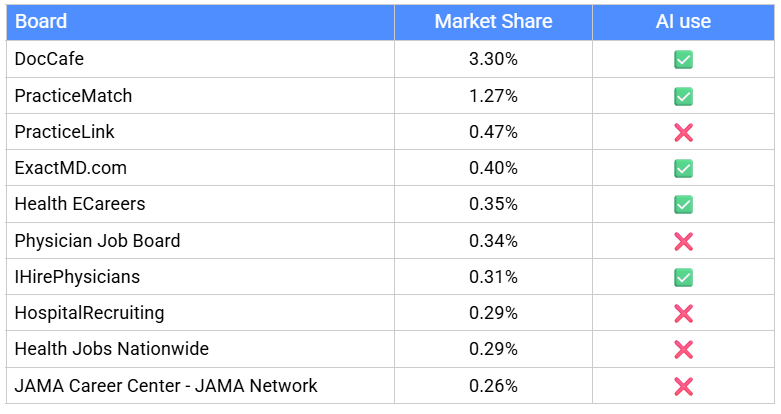
Figure 1: Healthcare Niche Boards – Market Share and AI Adoption
“Market Share” shows what percentage of all Google for Jobs Apply buttons in this industry come from each provider.
DocCafe alone accounts for 3.30% of healthcare-related Apply button visibility, followed by PracticeMatch at 1.27%. These platforms operate in an environment defined by licensing requirements, subspecialties, and regulatory constraints, where keyword searches alone fail to accurately filter candidates.
This aligns with broader industry reporting. CareerLeaf’s analysis explains that job boards increasingly use AI to validate credentials, infer skills from incomplete profiles, and suppress unqualified applicants before they reach recruiters. In healthcare, these systems reduce noise in applicant funnels and help prevent compliance issues tied to improper credential matching.
The Society for Human Resource Management has also noted that employers adopt AI tools primarily to improve job-candidate alignment rather than to replace recruiters, reinforcing why healthcare adoption occurred earlier than in other sectors.
Transportation: Scale Without Deep Matching Complexity
Transportation shows a more limited adoption pattern. Aspen’s dataset identifies TransForce as the only major transportation-focused job board publicly marketing AI-supported matching, holding a 2.08% visibility share within its category. Most other transportation boards rely on traditional posting and search models.
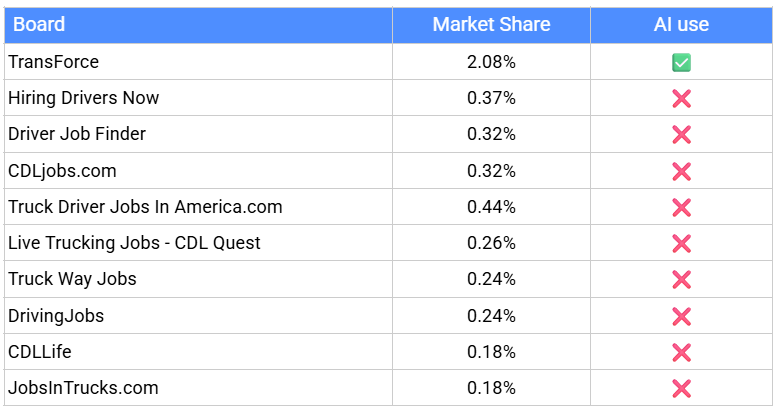
Figure 2: Transport Niche Boards – Market Share and AI Adoption
“Market Share” shows what percentage of all Google for Jobs Apply buttons in this industry come from each provider.
CNN’s reporting helps explain why. Many transportation roles depend on standardized certifications, such as CDL licenses, where binary qualification checks are sufficient. AI adds less marginal value when roles are uniform and screening criteria are straightforward.
That said, Built In reports that logistics and transportation platforms are beginning to experiment with AI for fraud detection, resume verification, and demand forecasting rather than deep candidate matching. This suggests that AI adoption may expand in this sector, but along different functional lines than healthcare.
Skilled Trades: Fragmentation Drives Selective AI Use
Skilled trades sit between healthcare and transportation in terms of complexity. Aspen’s data shows early AI adoption across platforms such as FactoryFix, BlueRecruit, iHireConstruction, and iHireManufacturing, though overall visibility remains fragmented across many sources.
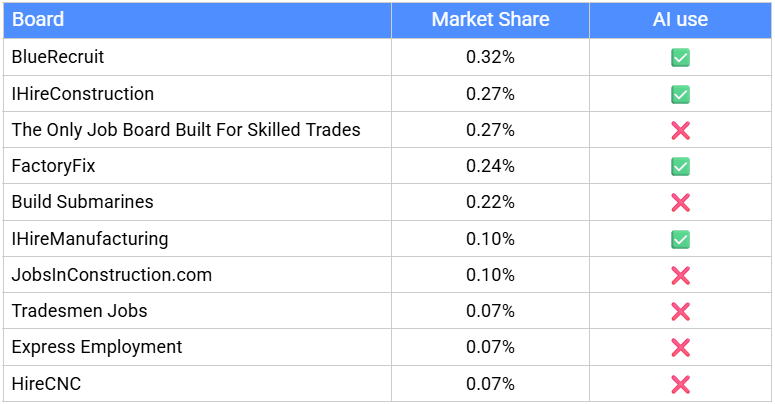
Figure 3: Skilled Trades Niche Boards – Market Share and AI Adoption
“Market Share” shows what percentage of all Google for Jobs Apply buttons in this industry come from each provider.
FactoryFix stands out as one of the more visible AI-driven platforms, despite holding a relatively small share of Apply button traffic. This reflects a broader trend described by CareerLeaf, where niche job boards deploy AI selectively to solve specific problems such as skills inference, certification matching, or employer ranking rather than rebuilding their entire platform.
Built In’s 2025 review notes that AI adoption in trades hiring is often constrained by data quality. Inconsistent resumes, offline credentials, and non-standard job titles limit the effectiveness of automated matching, slowing widespread deployment.
How Major Platforms Are Using AI at Scale
Large platforms have played a key role in normalizing AI-driven hiring infrastructure. According to AI Magazine, Indeed now uses AI across nearly every stage of the recruitment process, including job recommendation ranking, resume parsing, candidate-job fit scoring, salary normalization, and fraud detection.
Indeed reports that its AI models are trained on millions of job seeker and employer interactions, allowing the platform to refine relevance scoring and reduce low-quality matches. This approach mirrors trends described by CNN, where AI increasingly acts as a gatekeeper long before human recruiters review applications.
These systems are largely invisible to job seekers, which has fueled concerns about transparency and explainability. CNN notes that regulators and advocacy groups are pushing for clearer disclosures as AI becomes embedded in hiring decisions.
The Pattern Is Clear
Across industries, AI adoption follows hiring complexity and volume rather than hype cycles. Healthcare leads because credential-heavy roles demand better filtering. Skilled trades adopt AI selectively where specialization creates friction. Transportation lags in matching but adopts AI for operational efficiency. Large platforms normalize AI by embedding it deeply into search, ranking, and screening infrastructure.
As CareerLeaf summarizes, AI is quietly redefining how job boards work, not by replacing recruiters, but by reshaping who gets seen, when, and why.
See this data in action
Explore structured job data and labor market intelligence for your use case.